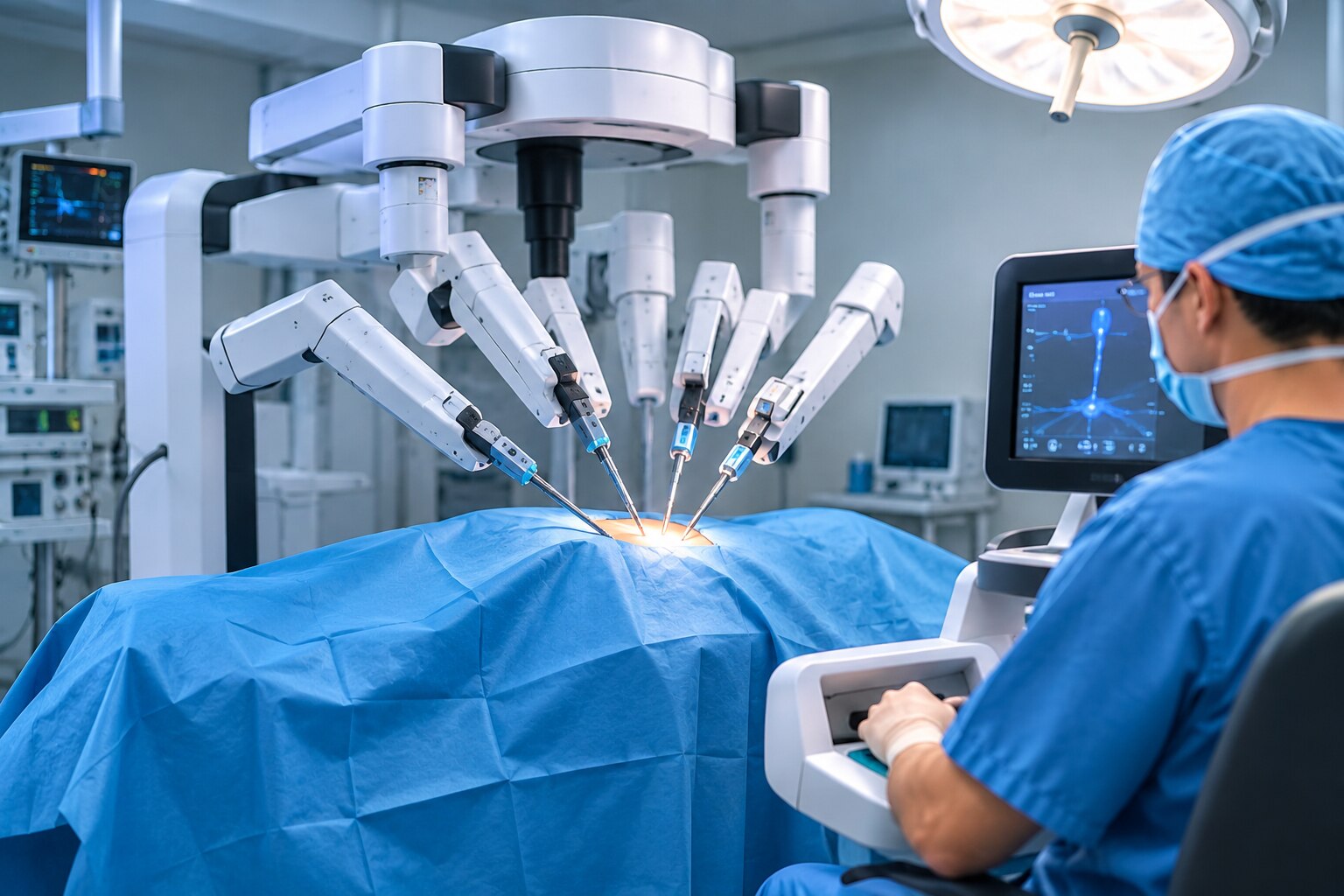
A complex abdominal operation is not automatically a robotic operation. By the end, you will know which anatomical and technical problems make robotic assistance useful, how it compares with laparoscopic and open surgery, and which questions reveal whether the approach fits your diagnosis, health and surgical team.
Key takeaways
- Complexity depends on anatomy, distorted tissue planes, and reconstruction—not the operation’s name.
- Robotic surgery offers wristed instruments and 3D vision but does not eliminate surgical risk.
- Ask what would make the surgeon convert from robotic or laparoscopic surgery to an open operation.
- Emergency timing, unsafe positioning, severe adhesions, or anaesthesia risks can make robotics unsuitable.
What makes an abdominal procedure complex?
A practical complex abdominal procedure definition focuses on anatomy, reconstruction and technical demands—not the operation’s name. Complexity rises when access is confined, tissue planes are distorted or reconstruction requires prolonged dissection and intracorporeal suturing.
- Pancreatic surgery and operations in a difficult upper abdomen can require dissection around major vessels, bile ducts and adjacent organs.
- Rectal cancer surgery becomes technically demanding in a narrow pelvis, especially with a low tumour, obesity or a need for precise pelvic suturing.
- Revision surgery after previous operations can involve severe adhesions that obscure anatomy and make bowel separation hazardous.
- Large or recurrent hernia repair may require multiquadrant dissection, mesh placement and reconstruction through awkward angles.
- A deep hiatus or other confined space limits instrument movement and makes bleeding control or nerve preservation harder.
Robotic surgery is most persuasive when these demands require precise work around major vessels or nerves, severe adhesiolysis, difficult-angle reconstruction or operation in a confined space. The surgeon controls every instrument; the platform supplies a stable camera, motion scaling, wristed instruments and a three-dimensional magnified view.
The robot does not provide normal tactile feedback or make tissue handling automatically safe. The surgeon judges tension, bleeding and thermal injury through visual and indirect cues, so experience with the named procedure remains central. A straightforward operation may gain little from robotic assistance.
How does robotic surgery compare with laparoscopic and open surgery?
Robotic versus laparoscopic surgery uses the same small-incision principle, so both reduce abdominal wall trauma compared with open surgery. Open surgery uses a larger incision and gives the surgeon direct hand access.
The robot adds wristed instrument articulation, stable camera control, motion scaling, improved ergonomics and precise intracorporeal suturing, but the surgeon still controls every movement.
| Option | Strengths | Trade-offs and expected outcomes |
|---|---|---|
| Robotic | Useful for a narrow pelvis, difficult angle or complex reconstruction; supports precise dissection and suturing | No direct tactile feedback; requires setup and docking; can lengthen operating time and anaesthesia; equipment costs more |
| Laparoscopic | Small incisions, reduced wound trauma and lower cost than robotic surgery for many operations | Straight instruments and a less flexible camera can make deep suturing or awkward dissection harder |
| Open | Direct hand access and rapid control during difficult bleeding or extensive disease | Larger incision, more abdominal wall trauma, greater wound burden and often longer recovery |
Blood loss and hospital stay, wound complications, bowel or urinary injury and anastomotic leak depend more on the operation, disease and team than on the robot alone. Robotic surgery does not guarantee fewer complications, faster recovery or lower total cost.
In rectal cancer, the ROLARR trial found conversion to open surgery in about 8% of robotic cases versus 12% of laparoscopic cases, without a statistically significant overall reduction. A straightforward operation may gain nothing clinically from robotics; a narrow pelvis or complex reconstruction may justify its added time and expense.
What does the surgeon assess before recommending a robotic approach?
The recommendation starts with the operation you need, not the presence of a robot. The surgeon reviews your diagnosis, tumour stage and planned resection using contrast CT or MRI imaging when indicated, plus endoscopy and biopsy results, blood tests, nutritional status and other staging information.
The assessment should cover three practical areas:
1. Anatomy and access: previous abdominal operations, the likely location of adhesions, body habitus, tumour size and whether safe entry and dissection are possible. Adhesions are not an automatic exclusion, but dense bowel adhesions can make robotic access hazardous.
2. Physiological tolerance: cardiopulmonary fitness, your ability to tolerate pneumoperitoneum and the required operating position, such as steep Trendelenburg position. Increased abdominal pressure or prolonged head-down positioning can be unsafe with significant heart or lung disease.
3. Team and procedure experience: ask about the surgeon’s recent volume, conversion rate and complications for the named operation. Experience with robotic hernia repair does not establish expertise in pancreatic, colorectal or pelvic cancer surgery.
The hospital must provide trained theatre staff, anaesthesia support, emergency undocking, blood products, intensive care when needed and treatment for leaks, bleeding and thromboembolism. The final decision is whether robotic assistance improves this specific operation enough to outweigh extra setup, anaesthesia time and cost.
When is robotic surgery the wrong or unsafe first choice?
An unstable patient with perforation, extensive contamination, uncontrolled haemorrhage or bowel ischaemia needs rapid source control, not time-consuming robotic docking. In elective versus emergency abdominal surgery, the fastest safe laparoscopic or open operation usually takes priority when immediate wide access is essential.
Robotic surgery contraindications also include extensive cancer spread, unsafe or unclear anatomy, equipment failure, severe cardiopulmonary disease, inability to tolerate pneumoperitoneum, or inability to remain safely positioned in steep Trendelenburg. These factors can make anaesthesia or access more dangerous even when the planned procedure is technically suitable.
Previous surgery and adhesions are not automatic exclusions. The decision depends on safe entry, how much bowel is involved, the adhesiolysis required and whether the team has a credible conversion plan.
A planned robotic operation can change during surgery because of:
- Dense adhesions that prevent safe dissection
- Unexpected bleeding requiring rapid control
- Locally advanced disease or anatomy that cannot be identified safely
- Equipment failure or inability to undock promptly
Conversion to open surgery, or to conventional laparoscopy, is a safety decision—not proof that the operation failed. Robotic assistance does not remove infection, anastomotic leak, ureteric or bowel injury, venous thromboembolism, bleeding or cardiopulmonary complications. If the operation becomes unsafe through the robot, changing route protects the patient.
What should you ask before choosing a robotic operation?
Ask questions to ask about robotic surgery that test the operation, not the machine. Start with the exact anatomical problem: does a confined pelvis, difficult angle, adhesions, vessel dissection or reconstruction make robotic assistance useful?
- What is the named operation, and what are the laparoscopic and open alternatives?
- How many of this operation has the surgeon performed recently? What do the surgeon experience and outcomes show for conversion, bleeding, leak, infection, stoma, reoperation and readmission?
- What findings would trigger conversion to laparoscopy or open surgery? Could the procedure require a temporary or permanent stoma or other permanent reconstruction?
- How long could surgery and anaesthesia last? What hospital support covers blood products, intensive care, emergency undocking and treatment of a leak or bleeding?
- What additional cost applies, and what recovery difference is realistically expected?
| Option | Main trade-off | Ask about |
|---|---|---|
| Robotic | Precise work in confined anatomy; added setup and cost | Procedure-specific results and conversion risk |
| Laparoscopic | Small incisions without robotic equipment | Whether it provides the same result here |
| Open | Direct access and rapid control | Larger wound, recovery time and complication risks |
A consultation for complex gastrointestinal surgery in Navi Mumbai should review your scans, endoscopy, biopsy, blood results, previous operations, anaesthetic risk and recovery priorities. Dr Chirag Vaja can discuss which route matches those findings; the recommendation should follow the anatomy and team’s procedure-specific experience, not the presence of a robot alone.
Frequently asked questions
What makes an abdominal procedure complex?
Complexity increases when access is confined, tissue planes are distorted, dissection is prolonged, or reconstruction requires intracorporeal suturing.
How does robotic surgery compare with laparoscopic and open surgery?
Robotic surgery uses small incisions, a camera and wristed instruments; open surgery offers direct access, while laparoscopy uses rigid instruments through small ports.
What does a surgeon assess before recommending robotic surgery?
The surgeon assesses your anatomy, imaging, previous operations, adhesions, medical fitness, anaesthesia risk, positioning tolerance and the team’s experience.
When is robotic surgery the wrong or unsafe first choice?
It may be unsuitable when urgent treatment is needed, positioning is unsafe, adhesions prevent safe access, bleeding is uncontrolled, or open access is safer.
What should you ask before choosing a robotic operation?
Ask why robotics suits your case, what alternatives exist, who will operate, how complications are managed, and when conversion to open surgery would occur.